Unfortunately, Oracle has effectively decommitted Applets. This means you can no longer run the various CMP programs in a browser. You must download them and install them.
You must have the most recent Java
JRE (Java Runtime Environment) 1.8.0_131
32-bit or 64-bit. It no longer matters which browser you use.
Oracle has effectively decommited Applets, so this Applet will no longer run online in your browser, but it is a hybrid you
can also download, install and run it on your own machine as standalone
application. It will start and run faster if you do that. It will also
work safely even if you have disabled Java in your browser.
Reuters Java Test for Unicode™ Standard Support
Reuters is an international
company committed to delivering news and financial information in all major languages.
The Unicode Standard is capable of representing all characters from all languages and its
use can greatly improve multi-language program development. Java uses the Unicode
Standard to represent all characters. Reuters have kindly provided this Applet for
displaying Unicode.
The Unicode Standard is capable of representing all characters from all languages and
its use can greatly improve multi-language program development. Java uses the Unicode
Standard to represent all characters.
Unicode Test Applet
In the applet shown below (Java enabled browsers only) 256 characters of the possible
4096 are displayed in
a grid. By clicking on the bottom and right sliders the
offset of this character window into the Unicode character set can be changed.
This version shows the 16-bit characters 0x0000 to 0xFFFF. It does not show the high 32-bit characters.
Java Requirements and Troubleshooting
Unicode
is a signed Java Applet (that can also be run as an application)
to Unicode.
You are welcome to install it on your own website.
If it does not work…
For this Applet hybrid to work, you must click grant/accept/always run on this site/I accept the risk
to give it permission to allow you to set the look & feel and to turn on anti-aliased fonts.
If you refuse to grant permission, the program may crash with an inscrutable stack dump
on the console complaining about AccessController.checkPermission.
In the Java Control Panel security tab,
click Start ⇒ Control Panel ⇒
Programs ⇒ Java ⇒ Security, configure medium security
to allow self-signed and vanilla unsigned applets to run.
If medium is not available, or if Java security is blocking you from running the program,
configure high security
and add http://mindprod.com
to the Exception Site List at the bottom of the security tab.
Often problems can be fixed simply by clicking the reload button on your browser.
Make sure you have both JavaScript and Java enabled in your browser.
Make sure the Java in your browser is enabled in the security tab of the Java Control panel.
Click Start ⇒ Control Panel ⇒
Programs ⇒ Java ⇒ Security ⇒
Enable Java Content in the browser.
This signed Java Applet (that can also be run as an application)
needs 32-bit or 64-bit Java 1.8 or later.
For best results use the latest 1.8.0_131 Java.
It works under any operating system that supports Java
e.g. W2K, XP, W2003, Vista, W2008, W7-32, W7-64, W8-32, W8-64, W2012, W10-32, W10-64, Linux, LinuxARM, LinuxX86, LinuxX64, Ubuntu, Solaris, SolarisSPARC, SolarisSPARC64, SolarisX86, SolarisX64 and OSX
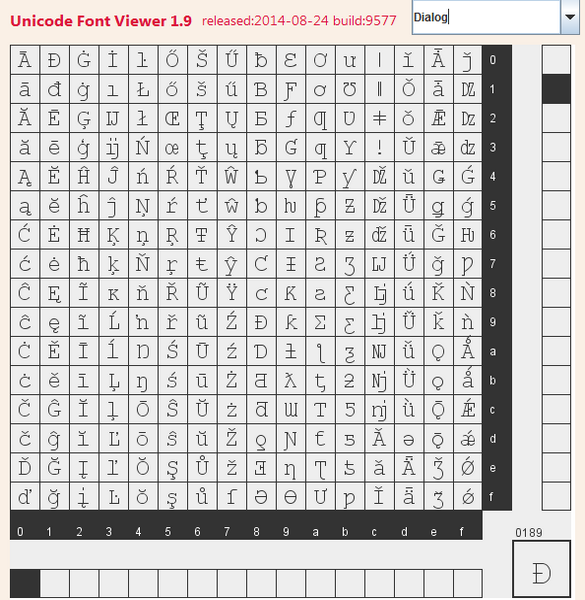
You should see the Applet hybrid above looking much like this
screenshot.
If you don’t, the following hints should help you get it working:
If the above Applet hybrid appears to freeze-up, click
Alt-Esc repeatedly to check for any buried permission dialog box.
If you have certificate troubles,
check the installed certificates
and remove or update any obsolete or suspected defective certificates.
The only certificate used by this program is mindprodcert2017rsa.cer.
Especially if this Applet hybrid has worked before, try clearing the browser cache and rebooting.
To ensure your Java is up to date, check with Wassup.
First, download it and run it as an application independent of your browser,
then run it online as an Applet to add the complication of your browser.
If the above Applet hybrid does not work,
check the Java console for error messages.
If the above Applet hybrid does not work, you might have better luck with the downloadable version available below.
If you are using Mac OS X and would like an improved Look and Feel,
download the QuaQua look & feel
from randelshofer.ch/quaqua.
UnZip the contained quaqua.jar
and install it in ~/Library/Java/Extensions
or one of the other ext dirs.
Upgrade to the latest version of Internet Explorer or another browser.
Click the Information bar, and then click Allow blocked content. Unfortunately, this also allows dangerous ActiveX code to run. However, you must do this in order to get access to perfectly-safe Java Applets running in a sandbox. This is part of Microsoft’s war on Java.
Try upgrading to a more recent version of your browser,
or try a different browser e.g. Firefox, SeaMonkey, IE or Avant.
If you still can’t get the program working
click the red HELP button below for more detail.
If you can’t get the above Applet hybrid working
after trying the advice above and from the red HELP button below,
have bugs to report or ideas to improve the program or its documentation,
please send me an email at.
The applet was written by Nic Fulton
in London of
Reuters You can download the
Java source.
Explanation
The slider at the base represents the first of the four hex digits of
a Unicode character. The right-hand slider represents the second digit. The grid of 256
cells should show the 256 characters whose Unicode codepoints start with those two hex
digits and the position in this grid makes up the third and fouth digits.
If you click on one of the characters, it will be displayed in the box in the bottom
right hand corner. Its full hex value will be displayed above it.
The first 256 Unicode characters are based on ISO-8859-1 (Latin 1). Many browsers are only able to display, in
Java applets, these 256 Unicode characters. To test
whether your browser supports more than the Latin-1 characters, try moving the sliders
away from zero and zero. For instance, the ideographic characters known in Japanese as
Kanji, in Chinese as Hanzi and in Korean as Hanja, start at U+4E00 (the Unicode Standard
uses the prefix U+ to indicate a Unicode character). Place
the bottom slider against 4, the right-hand slider against
E and you should see lots of Kanji characters.
Alternatively try setting the bottom slider to 0 and the
right slider to 3. In this case some Greek characters should
appear.
Does your
browser support the Unicode Standard?
If you were able to see Greek (U+0370 onwards),
Cyrillic (U+0400 onwards), Kanji (U+4E00 onwards) or other characters that were not in
the first grid, then your browser does seem to support the Unicode Standard in
Java.
If you were unable to see any other characters that were not in the first grid, then
your browser does not seem to support the Unicode Standard in Java, but you may simply not have the necessary fonts.
However, if by moving the sliders nothing changed then it is likely that the Java
Virtual Machine in your browser is chopping the top eight bits from each 16-bit Unicode character, leaving you with a Latin-1 character. This means
that your browser does not support the Unicode Standard in Java.
To see font samples in various colours of text and background see see the FontShower Applet.
To install, extract the zip download with WinZip,
(or similar unzip utility) into any directory you please,
often J:\ — ticking off the
use folder names option.
To check out the corresponding source from the Subversion repository, use the TortoiseSVN repo-browser to access unicode source in repository with [Tortoise] Subversion client on wush.net/svn/mindprod/com/mindprod/unicode/.
After you have installed the jar, you can run it as an application. Type:
java -jar J:\com\mindprod\unicode\unicode.jar
adjusting as necessary to account for where the jar file is.
Unicode is free. Full source included.
You may even include the source code, modified or unmodified
in free/commercial open source/proprietary programs that you write and distribute. Non-military use only.
Please read the feedback from other visitors,
or send your own feedback about the site. Contact Roedy.
Please feel free to link to this page without explicit permission.
Canadian
Mind
Products
IP:[65.110.21.43]
Your face IP:[216.73.216.207]


 .
. Get New Java
Get New Browser
Get New Java
Get New Browser

 in London of
Reuters You can download the
Java source.
in London of
Reuters You can download the
Java source.
 Does your
browser support the Unicode Standard?
Does your
browser support the Unicode Standard? ❘ precis
❘ screenshot
❘ browse source repository
❘ precis
❘ screenshot
❘ browse source repository
 3.0MB
zip for Unicode Java source, compiled class files, jar and documentation to run on your own machine either as an application or an Applet.
3.0MB
zip for Unicode Java source, compiled class files, jar and documentation to run on your own machine either as an application or an Applet.