

At this point 29 percent of fish and seafood species have collapsed — that is, their catch has declined by 90 percent. It is a very clear trend and it is accelerating. If the long-term trend continues, all fish and seafood species are projected to collapse within my lifetime — by 2048.
~ Dr. Boris Worm of Dalhousie University in Halifax, Nova Scotia, reported at discovery.com. Giant jelly fish have already replaced the Japanese fishery.
This is not a particularly cheerful essay. It is about the probability of man’s long term survival. Just how much longer will man be around on planet earth? Man is a relative newcomer to the planet, but gives all signs he will be a bust and will soon be gone.
Reading about our ancestors, you have to marvel at how they persisted through extreme hardships. Man is an adaptable animal that managed to survive from the arctic to the equator, in deserts and on the oceans. We have even survived ice ages.
We lived in small groups where everyone knew each other and where your loyalty was to the group. There was no need ever to plan more than a year ahead.
Yet, even before we invented technology, we stripped the forests of Greece bare and denuded her soils. The fabled Cedars of Lebanon were gone long before the chainsaw was invented.
Mankind faces a series of unprecedented threats. He is not capable of dealing with them because they overwhelm his here and now focus. They require thinking of the world as a whole. They require considering the effects on generations to come, not just the next quarter bottom line. I will consider only four of dozens of major problems threatening mankind: oil depletion, germ warfare, global warming and nuclear war.
Mankind today depends on technology and oil for the green revolution to feed her teeming billions. Oil is used to make fertilizers, pesticides and fuels for farm machinery and food processing. Without that, the population of the earth will have to collapse back to under a billion — what it was before these things were invented. According to Scientific American, by 2020 the flow of oil will have reduced to half what it was in 2000. The price will far more than double, effectively cutting off the poorer half of the world from having any. There is hope some new technology will help fill the oil-gap, but so far it is just a trickle. However, disruptive oil depletion may be, it is not extinction.
Mankind has discovered how to create life, molecule by molecule. Even an undergraduate geneticist can cook up a new form of AIDS (Acquired Immunodeficiency Syndrome) or polio. The very first thing man did with this new found knowledge was to create super bugs for germ warfare — e.g. inoculation-resistant smallpox. If these pathogens are ever let loose in error, by terrorists or by armies, they may kill billions, but that is still not extinction. However, as understanding of human physiology increases, it is only a matter of time until we learn to create pathogens completely lethal to everyone. That is extinction. Humans, genetically, are almost clones. We are much more susceptible than other species to this sort of attack.
The USA and Russia foolishly did the research to make it easy for every two-bit terrorist to destroy a city.
Mankind is embarking on a strange ecological experiment. Over a couple of centuries, man is burning the carbon accumulated over millions of years by plants. The CO₂ levels are now at the level of the Permian extinction. There have been two mass extinctions in earth history, the Permian, 230 million years ago, was the worst. 70% of all species were lost. It was caused by natural global warming when volcanoes released greenhouse gases. (The other extinction event more familiar to most people was the more recent KT Cretaceous-Tertiary Mass Extinction event, 65 million years ago. It was caused when an asteroid plunged into the earth at Chicxulub Mexico wiping out the dinosaurs and half of earth’s species.) We are re-experiencing the same global warming conditions that triggered the more devastating Permian extinction, only this time it is man made. When it gets too hot, plants die. When it gets too hot and dry, massive fires ravage huge areas. When plants die, insects and herbivores die. When insects die, even heat-resistant plant’s don’t get pollinated and die. Birds die without insects to eat. Carnivores die without herbivores to eat, all triggered by what seems so innocuous — heat. Similarly, in the oceans, when they get just a few degrees too warm, corals expel their symbiotic algae and die soon thereafter. When coral reefs die, the fish that live on them die, triggering extinction chains. Satellites can chart the loss of vegetation over the planet. We are losing 4 species per hour, a rate on the same scale as the Permian and KT extinction events. Man has no ability to live without the support of other species. We are committing suicide and killing the family of life on earth along with us. The question is, will we wipe ourselves out along with the rest of the planet’s ecology? Man is very adaptable. He will destroy his food supply on land and in the oceans as a result, but some people will survive. That is not complete extinction.
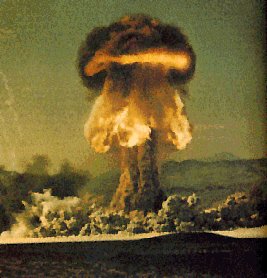
Mankind has discovered how to harness the atom. The first thing he did with that knowledge was vaporize two Japanese cities. Now he has stockpiles of weapons capable of killing everyone on earth many times over. Extinction becomes a distinct possibility. All it takes in one person in the next 500 years with access to the codes to trigger a war and it is all over. Perhaps a handful of humans might survive in some remote Amazon jungle, but man will have put himself back to the stone age level of culture. Everything we have achieved will be lost.
John Kennedy estimated that the odds were between one in three and one in two, that he would start a nuclear war during the Cuban Missile Crisis. Except on Star Trek, you can’t repeatedly do things that dangerous and live to tell about them. The odds eventually catch up with you.
Even after nuclear war, some life will survive. We humans may all die, but some species would survive and evolution would continue its slow pace, eventually bringing a new crop of creatures to earth.
To err is human, but to really foul things up requires a computer.
~ Farmer’s Almanac , 1978
This may sound like science fiction, but in the not too distant future we will be creating microscopic robots called nanites by the bucketful. Eventually we will create self-replicating nanites, ones that build more copies of themselves all on their own. It is not hard too imagine a runaway overpopulation process, much like Mickey Mouse in the Sorcerer’s Apprentice. If anybody ever slips up in birth control for these critters they could bury us all alive in great grey goo as they turned everything on the surface of the planet into still more nanites.
This is not my private paranoid fantasy. It is shared by distinguished futurists such as Ray Kurzweil.
Technological societies are so finely tuned that they can collapse at the tiniest provocation. There are only three days worth of food in the supermarkets. Terrorists can blow up high voltage transmission lines, subways or freeways. A single accident on the Mississippi river fouled up gasoline production in the USA for a month.If builders built buildings the way programmers write programs, then the first woodpecker that came along would destroy civilization.
~ Weinberg’s Second Law (1933-10-27 age:84)
Modern farming exposes the soil to erosion. We have lost more soil in the last century than took hundreds of thousands of years to build up. You can’t grow crops without soil. Every year, Kansas loses 2 to 8 tons of soil per acre of farmland. Yet, we refuse to address the problem.
Global warming will cause a dust bowl in the corn belt of the USA, ending its agricultural abundance.
The lungs of the earth are the Amazon rainforest and the algae in the oceans. These are absolutely necessary to soak up the CO₂ and produce oxygen. When we kill off either one through global warming, that is the beginning of the end. The Amazon rainforest is also in danger by logging. Global warming is messing with algae by changing the ocean currents that churn up nutrients and take oxygen back down to the depths. You can get in trouble either with too much or too little algae. We are messing it up 10 times faster than nature ever has in the entire history of earth.
Man is naturally greedy and short-sighted, but the invention of corporate capitalism (as compared with free-market capitalism) has magnified that tendency. We have created powerful institutions who bribe government officials to do things that help the short term profit of companies, but which hurt the health, safety of citizens and long term profit of corporations.
Corporations are pseudo people with psychotic personalities, required by law to be devoid of conscience. They are not permitted to be concerned with the interest of the stakeholders: the employees, the customers, the people living where the corporation does business. By law they must consider only profit for the shareholders.
They will do things like bribe the government to allow them to dump pollutants such as pig manure into the water, then fob the cost of cleaning them up on the public, rather than building them into the cost of the product, the way you would in a true free-market economy. Lack of care of the soil is good for short term profit, but soil loss is disastrous for the crops of future generations.
The problem is, these corporations are actively working as hard as they can against the public interest. For example.
Even without these corporate enemies of planet earth, our planet has little chance of success. Yet their power grows daily through phony free trade agreements like NAFTA and WTO.
In the Jehovist (extended Judeo-Christian) family of religions I include, Judaism, Christianity, Islam, Mormonism, Christian Science and JWs (Jehovah’s Witnesses). I might exclude the Quakers. The Jehovists are weak in preserving life on planet earth. This anti-life, anti-earth attitude has several roots:
In contrast, the Jains and Buddhists foster a reverence for all life. They are supposed to avoid hurting even insects. So what does this have to do with extinction? As science creates more and more ways for even one man to wipe out the entire planet, you need extreme taboos to stop people from doing that. Jehovists don’t have anywhere near enough inhibition. From my point of view, they are like Vikings who have accepted the values of violence and destruction as perfectly normal. They don’t even notice what they are doing. Everywhere they have spread they have stripped the planet bare, polluted its waters, overpopulated, made war, enslaved others, exuded greenhouse gases with abandon, squandered the resources of earth in conspicuous consumption, exterminated species after species and generally behaved like the proverbial savages they claim everyone else to be. They are far too vengeful to be entrusted with dangerous tools like the atom and biotechnology. Too bad. They already have them. The most powerful man on earth, George W. Bush was a fundamentalist Jehovist whacko who imagined the voices in his head telling him to butcher and torture, were God himself. Even president Obama imagines an imaginary friend in the sky will protect the USA from his blunders.
Man has little concern for other species on the ecological health of the planet as a whole. He ignores natural limits, simply because they are inconvenient. He imagines his economic activity can grow without limit, he can burn oil without limit, he can pollute without limit, he can extract resources from the earth without limit.
He is fiercely loyal to his country, his company, his team, his tribe, his family, no matter what evil things they have done.
Only a tiny fraction of the planet’s inhabitants see themselves as citizens of planet earth first and of some particular country second. Only a tiny fraction of the planet’s inhabitants care about people outside their immediate families. Only a handful of the planet’s inhabitants think deeply about the effect they will have on generations to come. It seem unlikely these altruistic survival traits will spread in time. Hanging on tenaciously to the outmoded us-vs-them mentality and short-term greed seals our doom. We deserve to die.
It may be a Good Thing™ that man blows himself up before he develops the technology to destroy an entire galaxy.
We know that asteroids crashing into earth wiped out most life on earth several times already. It is only a matter of time till one hits again. Astronomy has advanced to the point we would get at least a decade warning of such a collision. Though it is inevitable, it is not likely in the next century.
Man is a planet-destroying species, sort of like a planetary cancer. This might be cause for alarm to other intelligent species in the galaxy. We have broadcast our presence brazenly. It is only the speed of light that has kept our presence from being known throughout the galaxy. That knowledge is being broadcast in a rapidly spreading sphere of radio emissions that pollutes the galactic communication space. Some of those civilisations might take it on themselves to cure planet earth to stop the contagion from spreading or simply to make us shut up.
If you study elementary probability theory, you discover that if you have 20 threats, even if each one is not that likely to nail you, the probability that at least one of them will, is quite high. It is similar to the difficulty of throwing heads twenty times in a row.
Only very recently have humans been able to affect the planet as a whole with their actions, e.g. global warming, pollution, nuclear war. If humans made a mistake, usually at most 100 or so individuals would be affected. When you act in a way that affects 7.601 billion people, you have to be much much more cautious. You are playing with the potential extinction of the entire species. However, humans continue to use the same degree of caution they used around the cave camp fires. Psychologically, we are far too cavalier for such an interconnected world. Look how BP destroyed the Gulf of Mexico with hundreds of cavalier safety decisions.
We humans are victims of our own success. We rocketed from the cave to the computer overnight. We did not have time to make the necessary adjustments to our own psychology. We get in such trouble with our cavalier attitudes to safety and sustainability, with our territorial battles, with our religious superstitions. On a small scale, absolute selfishness is a workable strategy. On a planetary scale it is fatal.
Once man has colonised several planets, one planet could go up in a nuclear conflagration without destroying the rest. The survivors might be stonily shocked into giving up such foolish weapons. Until that point, if earth goes, man goes. Recall that the horror of Hiroshima stimulated the USA and Russia into a nuclear arms race.
Unfortunately, exploration of space has taken a back seat to military exploitation of resource-rich third world nations.
The other escape would be nuclear disarmament. Man is too stupid. He would rather see everyone die than his neighbour potentially take advantage of him. The USA wants its nukes not for defence, but to intimidate and bully the nations of the earth to bolster its economic exploitation. It won’t give up that privileged position.
Never doubt that a small group of thoughtful committed citizens can change the world; indeed it is the only thing that ever has.
~ Margaret Mead (1901-12-16 1978-11-15 age:76)
Young people are much clearer about man’s fragility than their elders. If we are lucky, the old farts like George W. Bush will die off from cholesterol poisoning before they have totally destroyed the planet.
Computers with the memory capacity and computing capacity of the human brain are due about 2020. They will do some things amazingly better than humans, just as now. Most likely, they will run circles around us in logical thinking. If we are very lucky, they may be very good at simulating the effects of various policies, and will be able to explain with 3D graphics exactly what the effects of the politicians’ actions will be. If they are sufficiently good salesmen, they may save earth. In the process though, we will have become obsolete ourselves. The bad news is the department of defense is doing most of the research. They want intelligent robots they can program to kill people. It is also possible that the computers could compassionately decide to euthanise us, since most of us humans are having a pretty miserable existence, or to prevent us from harming the surrounding galaxy.
I have one other thread of hope. Back in 1969, I was the only person on earth I knew of who felt that gays should be treated with respect. Even my fellow gays seemed to think they deserved contempt. I started my little gay lib project knowing it was completely futile. I thought, even if I did seven lectures a week and managed to change everyone’s mind in the audience, it would make only a tiny dent. Yet within three years we had the first gay rights legislation in British Columbia. Perhaps it was not just a co-incidence. I discuss this in my essay on quantum miracles. It may be your personal choice whether you live in a world where man goes extinct or in one where he prevails.
The natural reaction of someone reading this essay is to go into overwhelm. This is just too much bad news to digest at once. People have their own various techniques for dealing with it. The most common is denial. Gloom and doom must automatically be false. Folks will happily ignore the hard facts of global warming, soil erosion and aquifer depletion and glom onto any unscientific crackpot like Bjørn Lomborg or George Bush so long as he paints a rosy picture. Some will comfort themselves with wishful thinking. God won’t let things get that bad. totally forgetting God has been quite happy to permit even worse suffering in past. Some will simply put these issues out of mind.
The problem is this denial makes the problems worse. Not only to people fail to take action, they actively interfere with others taking action. So to be optimally effective, you must be upset and worry to some degree.
There are techniques, such as the Ken Keyes Living Love Methods, to stare head on into such grim facts without getting depressed. Unfortunately, they require a lot of work and discipline.
 |
recommend DVD⇒Earth at Risk: Building a Resistance Movement to Save the Planet | |||||||||||||||||||||||||
| DVD | ||||||||||||||||||||||||||
| by | Derrick Jensen | |||||||||||||||||||||||||
| birth | 1960-12-19 age:57 | |||||||||||||||||||||||||
| asin | 1604866888 | |||||||||||||||||||||||||
| upc | 760137535096 | |||||||||||||||||||||||||
| Jensen is a scruffy looking young man, unshaved, with a haircut that looks like his gardener did it with a lawnmower. Don’t let this put you off. He is a serious thoughtful man who does not pull punches about how seriously in trouble our planet is and why. He pushes you to look at why we are so reluctant to confront those responsible. Though there is no drama, this is utterly chilling. | ||||||||||||||||||||||||||
| ||||||||||||||||||||||||||
| Greyed out stores probably do not have the item in stock | ||||||||||||||||||||||||||
 |
recommend DVD⇒King Corn | |||||||||||||||||||||||||
| DVD | ||||||||||||||||||||||||||
| by | Aaron Woolf [Director] | |||||||||||||||||||||||||
| birth | 1964 age:53 | |||||||||||||||||||||||||
| asin | B0012680D0 | |||||||||||||||||||||||||
| upc | 767685236567 | |||||||||||||||||||||||||
| This is a rambling little film about two not-too-bright young men who decide to grow a acre-sized crop of corn. They don’t actually do anything. They hire people to perform the steps. In the process you learn about herbicides. You learn that most corn grown is not edible. It is used for animal feed, but it actually poisonous to cattle. You learn how astronomical agricultural subsidies came to be. They also learn about the ubitquity of high fructose corn syrup and how it is killing people. They never challenge anyone they interview. You come away with an understanding of how economics has driven agriculture into an insane place. The family farm is being forced out to be replaced by the factory farm. | ||||||||||||||||||||||||||
| ||||||||||||||||||||||||||
| Greyed out stores probably do not have the item in stock | ||||||||||||||||||||||||||
 |
recommend book⇒Sapiens: A Brief History of Humankind | |||||||||||||||||||||||||||||||||||||||||||||||||||||||
| by | Yuval Noah Harari | 978-1-84655-824-5 | paperback | |||||||||||||||||||||||||||||||||||||||||||||||||||||
|---|---|---|---|---|---|---|---|---|---|---|---|---|---|---|---|---|---|---|---|---|---|---|---|---|---|---|---|---|---|---|---|---|---|---|---|---|---|---|---|---|---|---|---|---|---|---|---|---|---|---|---|---|---|---|---|---|
| birth | 1976-02-24 age:42 | 978-0-06-231609-7 | hardcover | |||||||||||||||||||||||||||||||||||||||||||||||||||||
| publisher | Harper | 978-1-4945-5690-7 | audio | |||||||||||||||||||||||||||||||||||||||||||||||||||||
| published | 2015-02-10 | B00ICN066A | kindle | |||||||||||||||||||||||||||||||||||||||||||||||||||||
| The broad sweep of the history of our species from pre-history to the present day. What makes us different from other primates? What gives us our edge? What are our crucial flaws? | ||||||||||||||||||||||||||||||||||||||||||||||||||||||||
| ||||||||||||||||||||||||||||||||||||||||||||||||||||||||
| Greyed out stores probably do not have the item in stock. Try looking for it with a bookfinder. | ||||||||||||||||||||||||||||||||||||||||||||||||||||||||
It seems unlikely man will survive the next hundred years. The question then becomes, how many other species will man take down with him. Will the dolphins, elephants and whales have to die too?
Does this mean you should just give up and die right now? No. Butterflies and roses live only a day, yet they have value in the moment. If you were on a sports team playing a much stronger team. Would you give up just because the odds were against you? Of course not. Here the stakes are much higher than any sporting event, namely the survival of our species and most of the other species of our planet.
 |
This page is posted |
http://mindprod.com/environment/extinction.html |
Optional Replicator mirror
|
J:\mindprod\environment\extinction.html | |
 |
Please read the feedback from other visitors,
or send your own feedback about the site. Contact Roedy. Please feel free to link to this page without explicit permission. | |
| Canadian
Mind
Products
IP:[65.110.21.43] Your face IP:[216.73.216.250] |
| |
| Feedback |
You are visitor number | |


