aka video recording means keeping a local copy of a video
you can view online on the Internet. Often you need to download a video, either to
keep a copy in case the original is withdrawn, or to transcribe it. Sometimes all you
have to do is click a download button. Usually those
hosting the videos don’t want you to do that. They are worried you will pirate
the video, put it on your own website and get the associated advertising revenue
instead of them, or look at it yourself over and over without having to wade through
the ads on the front. People hosting the videos go out of their way to make it
difficult for you to keep a copy.
How To Download
Use the free trial versions to give various hacking
tools a crack at downloading your video. They will have the best chance of success on
the famous hosting sites such as YouTube. There is no guarantee they will work in any
given situation. It is an escalating war game between hosters trying to stop you from
downloading and the crackers attempting to defeat their defences. Most tools with
only one with one or two formats of video stream. To confuse you, hosters often lie
about the type of stream they are feeding, for example they will claim it is Flash
when it is really Microsoft or claim it is Real Audio when it is really Quicktime.
Browsers automatically see through the lie by paying attention to the
MIME (Multipurpose Internet Mail Extensions) type the server sends.
Possible Video Formats
Possible video download formats
| Video Links Legend |
|---|
| streaming or downloadable |
|---|
| Click corresponding icon to download player. |
|---|
| Apple QuickTime |
 |
| BitTorrent |
 |
| DailyMotion |
 |
| DivX |
 |
| DVD |
 |
| Flash animations |
 |
| Google |
 |
| HTML5 |
 |
| Microsoft Media Player |
 |
| Microsoft Power Point |
 |
| mpg |
 |
| mp3 |
 |
| mp4 |
 |
| Real Player |
 |
| Shockwave |
 |
| VHS tape |
 |
| Vimeo online video |
 |
| YouTube |
 |
| unknown |
 |
| lyrics |
 |
| transcript |
 |
Manual Cracking Steps
If none of the commercial cracking tools
you try work, you can attempt some simple manual cracking on your own. It is not that
difficult, but it is not something for a novice. This essay is by no means a
fool-proof recipe, just some general hints on how to proceed. Your steps are:
- Find the true name of the actual video file you want to download.
- Convince the server you are an ordinary browser desiring to play the file
online and download that file, usually in some special streaming protocol, not
HTTP (Hypertext Transfer Protocol) or
FTP (File Transfer Protocol) e.g. using NetTransport
- Convert that file into the format you prefer, e.g. MP3, e.g with GoldWave.
- Feed that local copy into a player for viewing, e.g. with VideoLAN.
Browser View Source
View source the web page where the video
image appears. Look for URLs (Uniform Resource Locators)
that end in .swf or other video extensions. Try playing them
directly. Your might be able to download such a file you find with :
java com.mindprod.filetransfer.Download -jar filetransfer.jar http://s.ytimg.com/yt/swf/watch_v8-vfl49669.swf whatever.swf
download is part of the FileTransfer package
Wireshark
Run Wireshark with capture filter tcp port
80 and display filter of http.request.method ==
GET. Then let it watch you start up the video in
your browser. Once it has started playing, stop the Wireshark capture. This will give
you a list of all the web pages and files your browser downloaded. Some of them will
be the videos you want. Right click a candidate to see the details of the download
request. Then use the download utility, part of the
FileTransfer package to
download them.
You may end up downloading a lot of frogs before you find your prince. Check the
Mime entry to find the likely file name
extensions for the sort of file you are looking for.
Russian Dolls
You may see .asf
files being downloaded. These are Microsoft playlists. They contain
XML (extensible Markup Language). Download them and look inside to find the
URLs
of the actual video files. They will contain URLs
of the form mms://video.cpac.ca/cpac/20/AR_CPAC3E6480.asf.
Unfortunately, the server likely won’t let you download them with ordinary
browser HTTP protocol. You will need some special program, such as,
NetTransport, to speak
the mms: protocol to the server to download instead of
play. NetTransport can speak:
- HTTP/
HTTPS (Hypertext Transfer Protocol over SSL (Secure Socket Layer))
- FTP/ through
SSL (Secure Sockets Layer)/SFTP (Secure File Transfer Protocol)
(SSH (Secure Shell)
File Transfer Protocol)
- MMS (Microsoft Media Server) (Microsoft Media Services)
- RTSP (Real Time Streaming Protocol) (Real-Time Streaming
Protocol)
- BitTorrent
- eMule
- RTMP (Real Time Messaging Protocol) (Real Time Messaging
Protocol)
Loopback Audio Recording
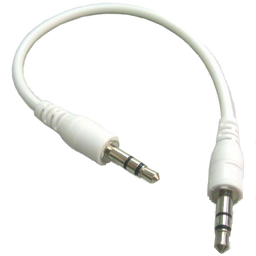
loopback mini audio stero plug
 |
| loopback mini audio stero plug |
Conceptually you could capture the audio-only
from a video, by playing the video in your browser and tape recording what comes out
the loudspeakers. Then you could play that back into the microphone to some sound
capture software like GoldWave.
You could do that more elegantly with a patchcord that loops the output of your
sound card back into the input port. Then you don’t need a tape recorder. You
record live.
You can do that even more elegantly (and with less static) by electronically
looping the internal digital output of your sound card back into the input using a
software utility.