The CurrCon Java Applet displays prices on this
web page converted with today’s exchange rates into your local international currency,
e.g. Euros, US dollars, Canadian dollars, British Pounds, Indian Rupees…
CurrCon requires an up-to-date browser
and Java version 1.8, preferably 1.8.0_131.
If you can’t see the prices in your local currency,
Troubleshoot. Use Firefox for best results.
Introduction
This is a rough plan for an EEEEEEE (Ecological, Energy—Efficient, Earthquake-resistant, Easy to maintain, Exercise, Experimental)
house.
Goals
To create a model house with:
minimal negative impact on the environment.
energy-efficiency.
disaster resistance, especially earthquake, for my part of the world.
low maintenance. Easy to clean.
kid and pet resistance.
fun for guests of all ages and species.
built to serve many generations, it avoids the trendy or showy.
does not try to please everyone, but rather to deeply satisfy the people who
actually use it.
good value, suitable for mass production.
The house attempts to blend with its environment, integrating natural light, water,
earth, plant and animal life into its basic design. It might look more like a
conservatory than a conventional house, with its plants and vegetables growing
everywhere.
Basic Design
Please feel free to change any of the design details to suit
yourself. I have provided my own decorative details to give a concrete example
of how such a house might look. I wondered if perhaps I should not be so specific, since
many of my specific choices may not appeal to you. The pictures I show are only rough
approximations to what I have in mind. They are the best I could come up with using
images.google.com
The house is a 3-story plus basement, heptagonal (7-sided) cylinder placed on a
sloping wooded lot in a rural setting in British Columbia, Canada. Each floor has a theme
that unifies its activities:
sensation: stereo, TV, home theatre for anyone who wants to drop by, bathing,
lounging, games, play, roughhousing, community meetings.
power: the home office, Internet connections, writing, computer controls. It is
just a partial floor to give the security floor below a higher ceiling for part of
it.
love: the bedroom, meditation, massage room.
universal connection: the roof is a garden, a place where you can bask and look at
the stars. It would be a safe place for birds.
Energy Efficiency
This area I have not researched properly. I would be interested
in your ideas at
.
The house is tall and skinny to make maximal use of natural light and natural
convection to distribute heat. The additional natural light encourages occupants to arise
with the sun and further reduce their dependence on artificial light.
Possible state-of-the-art technology to investigate includes:
Use of triangles, hexagons, heptagons… not just rectangles, in construction,
for variety and greater strength to weight ratio.
Tilapia (a fish of the cichlid family from Israel that can be farmed indoors). They
taste a bit like trout with the texture of salmon. You can buy live fish for about
each in a pet store or
each in a supermarket. Fish breeders still need to work on shrinking the bones (as the
breakfast trout breeders have done) and blunting the dorsal spines.
Capture the mechanical energy of people exercising or moving about the house.
Designs that make recycling of energy and materials a matter of course.
Earthquake Preparedness
The building is mounted on a flexible base similar to that used in Japan for
commercial buildings.
There is a fireman’s pole to
use for rapid evacuation down the centre of the building. There is a second
fireman’s pole outside the building, accessible from the roof. It has a
bungy-cord mechanism to protect you if you slip. These are also there for the sheer
fun.
There are ladders beside the fireman’s poles. This gives additional exits and
access in deep snow or fire. Other means of moving around the house are described
later.
Internal surfaces are rounded and, where practical, padded.
There is a cistern on the roof that can collect rainwater. Normally it is kept full
from the water mains.
There is a small pond and natural-looking fountain on the roof. There are aquaria
on each floor, one for tree frogs and for fish from the Amazon, Thailand and
Madagascar. These provide additional emergency water.
The plants and aquaria sit in troughs designed to catch water spills.
There are no knick-knacks, with the exception of large National Geographic statues
of marine mammals which are suspended from the ceiling.
The cupboards and bookcases on every floor have heavy-duty catches similar to those
used on yachts.
The house is heated by a high-tech wood stove and water pipes and equipped with a
12-volt thermovoltaic 12-volt backup system.
Computer power backup (just long enough to shut down).
There are no lamps or other furniture that could tip over.
Any pictures are either bolted to the wall or unframed.
The tall skinny lighthouse-like design should be more resistant to winds, floods
and tidal waves. It should also make it possible to hold up the floor without heavy
internal beams.
There is an emergency larder of non-perishable foods that do not require
refrigeration, cooking or electricity. The larder would also include some foods that
require fire to prepare such as flour and dried beans. These foods would be consumed
and replaced on an ongoing basis.
All these features also tend to make the house pet and kid-resistant and kid-safe.
Because nearly everything is nailed down, it is fairly safe
to allow strangers or homeless people to stay overnight.
Hurricane Preparedness
The building offers a relatively streamlined profile to
the wind which should reduce damage. In a flood, you could move to the higher floors and
use the top floor as an ultra secure area for refuge or storing valuables, safe from
looters. I would imagine these buildings in hilly or mountainous areas so they would have
a sound bedrock foundation. There are types of glass that are hurricane resistant. They
will break when hurricanes throw debris at them, but they won’t shatter or allow
debris into the house. In hurricane regions or regions of extreme temperature, you would
go easy on big windows and make do with smaller porthole type windows.
Easy To Clean
This is a house to be lived in and to entertain guests casually.
Each floor is a single room as much as is practical. In addition to making the house
easier to clean, this gives it a feeling of spaciousness and allows natural light to
penetrate.
There is a computer controlled irrigation system to ensure all the plants get the
optimal amount of water and fertiliser.
The floors are mostly of seemless linoleum with rounded corners, hospital style, so
there is no groove to catch dirt. They simulate natural smooth horizontal surfaces such
as rock, moss, sea sand, leaf-covered forest floor, desert, lake, duckweed, stream
bed… even lawn. The patterns mask stains. The closest I have yet found to such
floor coverings are the Mannington
Naturals.
The furniture is well padded with a leather-like surface that is durable and easy to
clean.
Materials used throughout the home should not give off fumes, should be fire
resistant and should cause minimal impact on the environment to manufacture. Most
internal finishes are natural woods, perhaps treated for durability and
fire-resistance.
The plumbing is designed to be easy to clean, perhaps even on the industrial side. The
durable taps have levers instead of knobs so people with weak grips can use them.
The plumbing and wiring run in easy-to-access ducts for ease of repair and
upgrade.
Decor
The decor is based on natural woods, living plants and visual spaciousness.
Beige is all but banished.
Exterior
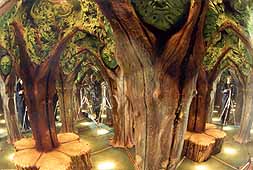
The building is intended to roughly look like a giant tree stump.
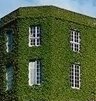
Perhaps the exterior could be covered in bark or something similar. Ivy or other climbing
vines may complete the illusion.
The landscaping is naturalistic and low maintenance, using native plants. Landscaping
elements look as much as possible like plausible natural creations. The house wishes to
disturb its environment as little as possible. It knows it is an intruder and tries to
compensate.
First Floor
The south side is all glass. A greenhouse is attached to the south
side of the house. You enter via the greenhouse where citrus trees grow. The greenhouse
collects heat for the house, but is separate from it in case the house gets too hot.
The first floor is one big room, an extended kitchen. The laundry area has
state-of-the-art washer and dryer that use minimal soap and water.
There is an area to store and maintain bicycles.
The foyer has a West Coast Native motif. The floor is slate which does not show the
dirt. The foyer has a bear box lit with track lighting. This is part of the
blend-with-your-environment theme. I had something darker and unpainted in mind, but this
gives you an idea what a bear box is.
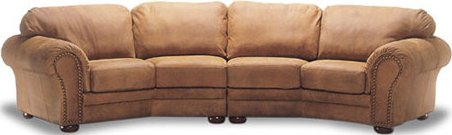
The waiting area has comfy tan chairs/couches. There is a statue of a Thai-style
Gautama Buddha — spare, clean, something like this:
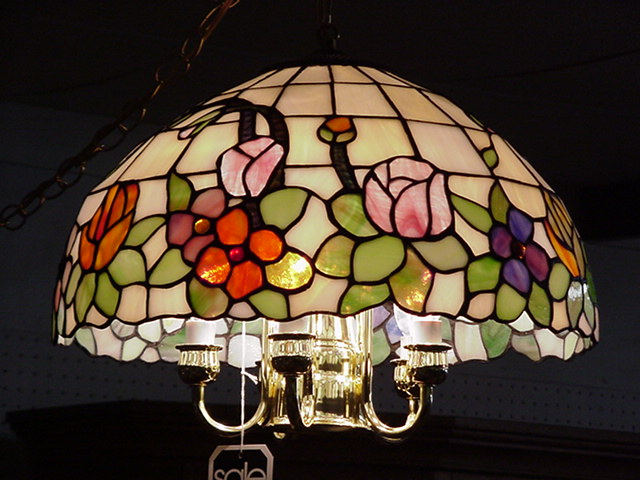
Hanging stained-glass lamps make it welcoming and invite reading. Perhaps a citrus
tree theme could be used, but almost any Tiffany-style lamp looks spectacular.
There is a fireplace. The spiral staircase leads into the waiting area, allowing for
residents to make a mildly dramatic entrance.
There is a composting toilet. There is a shower big enough for more than one person at
a time.
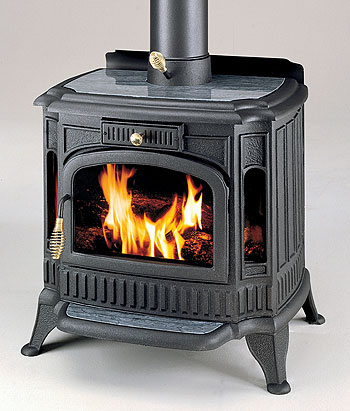
The kitchen area psychologically centres around the woodstove. Ideally the woodstove
would be have a Euro-style bread oven and a cooking surface mainly for boiling water.
The furniture is light wood. It has an island to makes it easier for several people to
work at once in the kitchen. It is taller than the other counter space to partly block
the view of the other counter space from the living area.
There are sufficient outlets for all appliances to be plugged in at once. The cords
are trimmed to the appropriate length and are colour-coded to keep people aware of how
much power each appliance consumes.
A smiling sun is affixed to the wall.
There are ceramic tiles, some depicting nature themes, on the splashboard. I have
already acquired my first such tile.
There is a herb window garden.
Basement
The basement theme is a womb with a view. It is done in light
woods, with yellows and oranges. It has a platform suspended from the ceiling that you
could sleep or swing on. The couches are long and comfortable enough to sleep on.
Bathing might be handled with a restored bright yellow clawfoot bathtub or a hot tub
or whirlpool — whatever is the most energy efficient. If there is sufficient
privacy, you can look out the tub into the surrounding woods. The bathroom toilet can be
used in privacy even while others are bathing.
An alternative design would use a more formal room on the second floor. You might then
elect to bypass the basement.
The basement has two sides all glass overlooking the downhill slope view.
The basement also acts as a guest room for overnight guests. Some of these guests
might be tempted to steal, so the room is designed to lead them away from temptation.
There is almost nothing to steal. The room would also act as an informal community
mini-theatre where people, especially less-affluent people, would feel welcome to drop by
almost any time and play DVDs (Digital Video Discs)
on the home theatre system.
Third Floor
This home office floor looks like something out of an Ikea catalog (a Swedish furniture store), but more
built-in. There is plenty of desk space, ergonomically designed. There is no clutter of
cables or manuals. Flat panel displays further reduce the clutter. The colour scheme is
light woods and dark greens. The computers are operated with voice control and ergonomic
Dvorak keyboards. There are hand-held
digital recorders so you can record thoughts that come to you away from the computer for
later transcription.
There are a few hammocks so you can take a break or a nap, or just think.
There are windows on three sides on the north side to avoid glare. The windows are
floor to ceiling to encourage taking a break from work to reconnect with the
environment.
Fourth floor
The bedroom is done in dark woods.
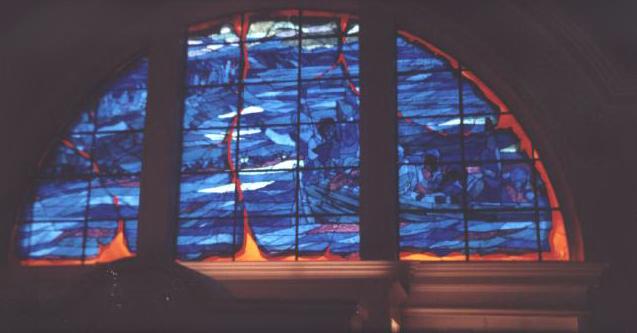
The four east walls are done stain glass, mostly in blues and greens. The stain glass
panels are backed by the usual glass thermal windows for protection and insulation. The
lead calms (pronounced came) let the glass breathe giving it resistance to thermal stress and earthquake shock.
Shatter resistant coloured glasses predominate.
In the meditation area is a lush carpet of mossy greens. There are some Tempur-Pedic beds and a stationary massage table.
There are clear panes so that you can see:
The rising sun in the morning.
The setting sun in the evening.
The stars at night.
There is a clear skylight so you can see the stars at night and a clear window so
that you can see the rising sun in the morning.
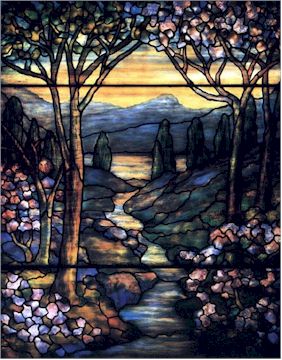
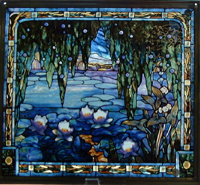
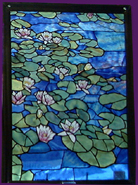
Here are some sample stain glass work done in blues and greens to give you and idea of
what I had in mind. The themes would be local wildlife and plants e.g. orca, dolphin,
bear, moose, deer, beaver, frog, salmon, trout, bee, water lily, cattail, dogwood, salal,
blackberry, salmonberry, blueberry, wild strawberry… done in a simple style with
textured glasses providing most of the detail interest.
The central panel might depict earth from space using the traditional painterly style
of stain glass fused in a kiln, or perhaps by stirring molten glasses.
Mandelbrot’s blue green period.
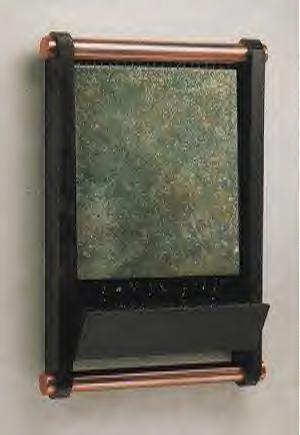
There are wall-mounted candle holders, again reiterating the nature theme. Ideally
they would be combined with a capsis wall-mounted
fountain.
Roof
Planting with native plants and stocking the pond with native species helps
minimise the net impact. If you look down on the house from above, it should look much
like the original plot of ground. The house disturbs as little ground as possible.
Alternatively, the roof could be a more conventional flower or vegetable garden
supporting an abundance of plant species.
Inter floor communication
There are staircases connecting floors, conceptually a
single spiral staircase. They need to be solid and quiet and non-slippery. The stairs
are more gently sloping than is conventional to make it easier for wheelchair ramps and
to make it easier to run up and down them safely. There is a boOracle’s chair beside
the fireman’s pole to lift people who cannot handle stairs to the upper floors.
The fireman’s poles and the ladders, while ostensibly for emergency evacuations,
may become the preferred means of getting around the house.
The Jphones make pleasing organic
tones depending on whom they are for. They only ring on the phone nearest the
recipient.
The intent of the building is to encourage you to naturally exercise climbing
stairs.
Sound System
The sound system could be an essay in itself. It is easy
to use, even in the dark, even by
guests. It works much the way in-flight music works on commercial aircraft, but has a
more sophisticated implementation.
All around the house are digital loud speakers and jacks for headphones. Eventually
technology may permit cordless headphones. Beside each speaker or jack are four
controls:
channel thumbwheel
volume dial
forward button
back button
The channel thumbwheel lets you select one of 99 music channels to listen
to. There are also live audio feeds from AM/FM radio and TV. There are also spoken word
(educational, hypnotic, talking books) channels.
The volume dial won’t let you accidentally turn the volume up so loud
that you damage your hearing, even if you are currently listening to a quiet passage.
If you don’t like what is playing on a channel, you can fast forward it by
holding down the forward button. If you want to hear something again, you can
press the back button. If you want to pause the channel, press the
forward and back buttons at once. If you press forward or
back it won’t disturb anyone else listening to that channel.
A central computer on the third floor runs the entire sound system. It has digital
versions of the CD (Compact Disc), tape,
DVD (Digital Video Disc)
and MP3 collections on a giant hard disk. You can compose what is to be played on the
various channels by sitting at the central computer. You can add optional voice
introductions to each segment. You can allow different meanings for the channels for each
member or guest of the household. That way nursery rhymes won’t clutter your
channels and your adult materials won’t clutter the channels of the children.
How does the computer know who is using which outlet so it knows which set of channels
to apply? You might simply assign specific outlets to various housemembers and guests.
More sophisticated technology would allow a guest to identify themselves.
A prototype implementation could use portable MP3 players and
USB (Universal Serial Bus) ports to download a few hour’s worth of sound into
them at a time. However, that would not give you live feeds. A memory card in the MP3
player with a wireless LAN (Local Area Network) port would give you live feeds.
Eventually you want video, telephone, voice dictation, voice messaging and intercom
service distributed by the same integrated system.
Plumbing
The plumbing fixtures are:
ultra-durable built to last for generations.
brushed nickel-coloured finish that will look good for generations.
very plain, sturdy, ergonomic design, not trendy. Think Paul Revere silver designs.
No ornamental doo-dads.
dual lever, wide set so no confusion about how to operate.
extremely easy to clean, no crevices.
I scoured the Internet looking for bathroom faucets. I could find not a one that met
these criteria. I thought perhaps I should be looking under industrial designs to find
something suitable. I want to avoid the industrial gleam though.
Washroom floors are covered in non-slip tile, gently sloping to a drain. This
automatically handles spills and makes it possible to rapidly clean the entire washroom
with a pressure hose.
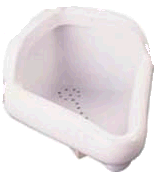
There is a unisex flush-type urinal on each floor. Males use them the traditional way;
females back up and hover. These use less water to flush that a full toilet. A more
traditional design would use wall-hung flush toilets that are easier to clean than
floor-mounted ones.
There is a composting toilet on the ground floor and a flush toilet in the
basement.
What’s Missing
What this particular version of the house does not have is:
a garage
a dining room
a living room
elevators
dumbwaiters
lawn
I deliberately left these out because we would only rarely use them.
A simple plastic sheet could serve as a garage.
The kitchen and basement could be transformed to act as dining room and living room
for special occasions.
Removing elevators encourages exercise.
Lawns need to be big, flat and well maintained to be much use. A sloping property
is not the place for them.
Outstanding Questions
How small can you make the house? How small can you get it for 1, 2, 3, 4, 5
people?
How do you construct access to the roof without wasting heat or letting in
water?
What should it be constructed of?
Where stained glass is used, how do you insulate?
How do you ventilate?
How do you stop the top floors from getting too hot?
How do you recycle the heat from the computers on the home office floor?
Where does the cistern belong?
Where do you put the photovoltaic and solar hot water panels?
How to make it more energy efficient? What is the best way to collect and store
heat
How do you stop burglars, vandals or other unpleasant people from doing
damage?
What have I neglected to consider?
Inspiration
Here are some sources for inspiration for designing your own e-house:
Crystal Gardens in Victoria BC Canada. This was a giant greenhouse with tropical
plants, fish, frogs, reptiles, mammals, butterflies and people all integrated. It cost
only
for a year-long pass. Unfortunately the mayor destroyed all the endangered species of
plants and animals that live there to make room for a convention center and casino.
Book referral for Handmade Houses: a guide to the woodbutcher’s art
recommend book⇒Handmade Houses: a guide to the woodbutcher’s art
Dream and share your dreams, even if you can’t yet afford an e-house of your
own. Your designs can still inspire others.
Oprah’s Dream E-house Contest
I have been trying to talk the Oprah Winfrey people into doing a show on
e-houses. The show would be based around a contest where people submit detailed designs
for their dream houses, right down to the paint colours, furniture and fabrics. The best
design gets the e-house custom built and the land to build it on. To reduce the work for
Oprah’s staff in judging, the contest rules work like this:
The ranking process is 100% automated. A computer
continually updates the rankings as the judges’ results come in and posts them on
the Internet.
Oprah makes the final decision. She can pick any entry she chooses. This will help
discourage foul play.
The judges are subscribers to Oprah Magazine and people who make submissions.
Judges can grade any of the entries from 0 to 100%.
People whose entries are judged good by others, get more weight in judging the
other submissions.
You can keep improving your submission even after you submit it.
Judges can keep changing their minds about the grades they assign.
The entries are judged by the criteria mentioned
earlier. In the process, people would learn a lot about e-house design. People would have
fun dreaming and window shopping on the Internet. Many of the ideas would find their ways
into real homes.
I this contest is held, I will have already won, in the sense that there will be many
e-houses sprouting over the planet.
I have had second thoughts. I blew an entire day just looking at bathroom fixtures.
Private residences consume huge amounts of time and energy. Perhaps the future is
e-apartment complexes. Another challenge would be mobile ehouses, floating ehouses and
eyachts.
Please read the feedback from other visitors,
or send your own feedback about the site. Contact Roedy.
Please feel free to link to this page without explicit permission.
Canadian
Mind
Products
IP:[65.110.21.43]
Your face IP:[216.73.217.43]


 .
.