


I never asked but I heard you cast your lot along with the poor. How come I overheard your prayer that you be this and nothing more than just some grateful, faithful woman’s favourite singing millionaire, the patron saint of envy and the grocer of despair, working for the Yankee dollar? I know you need your sleep now, I know your life’s been hard, but many men are falling where you promised to stand guard.
Leonard Cohen (1934-09-21 2016-11-10 age:82), in Field Commander Cohen
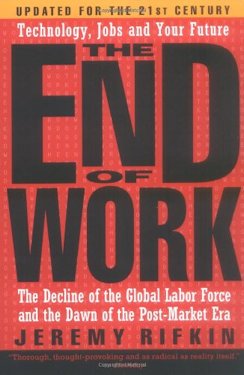 |
recommend book⇒The End of Work | |||
| by | Jeremy Rifkin | 978-1-58542-313-2 | paperback | |
|---|---|---|---|---|
| birth | 1945-01-26 age:73 | 978-0-87477-779-6 | hardcover | |
| publisher | Tarcher | |||
| published | 2004-05-11 | |||
| Rifkin traces the trends doing more with fewer people and ever increasing unemployment. Eventually machines will even undercut even the 6 cent an hour third world labourers. We are moving toward corporations without any workers. Corporations and automation are creating immense wealth, but they are not doing anything to help share it, the exact opposite. They are creating a super elite and a super poor class. | ||||
| Greyed out stores probably do not have the item in stock. Try looking for it with a bookfinder. | ||||
In the short term, the main way to increase employment is to reduce the work week. By reducing the work week from 5 days to 4:
The other stop gap measure is to reward companies that can absorb unskilled workers by offering a subsidy to hire them. Governments can afford the subsidies because of reduced social safety net payments.
We can also just close our eyes to the problem and let the market solve it. A pool of skilled unused labour willing to work below minimum wage, will eventually trigger entrepreneurs to find new ways to employ them. For example, in Malaysia, when you go to an upper class department store, a store employee is assigned to help you on your shopping expedition. He guides you through the store. In Indonesia, even a tiny gum stand will have no fewer than three clerks.
However, these are only temporary measures. Computer technology relentlessly eats away at all forms of employment. It will even eventually destroy even the shit jobs like flipping and serving hamburgers at McDonalds.
The progress was steady, but the effect on the workers came overnight. I anticipate that this pattern will repeat. Millions of white collar workers will find themselves overnight unemployed as gradual advances in AI (Artificial Intelligence) reach the stage it is better than humans at task after task.
Artists may continue, simply because people may prefer works of art created by famous humans to superior works of art created by AI.
Famous interior decorators will be busy helping people make the daily choices in clothing, cosmetics, jewellery, furnishings, appliances, cosmetic surgery etc. to create the in chic look. Eventually that too could be taken over by AI.
We may find people preferring artificial companions, who can be much more agreeable and entertaining, than real ones. The 1970s movie The Stepford Wives explored this possibility.
How many people would be satisfied with a human companion when they could have an artificial one that looked exactly the way they wanted, smelled the way they wanted, felt the way they wanted, behaved the way they wanted (including just the right amount of spunk and rebelliousness), was interested in the things they were interested in, who liked washing dishes and doing the laundry…
Star Trek Voyager explored this Pygmalion theme when the Captain Janeway fell in love with her Irish male creation on the holodeck. She kept fiddling with his program to make him ever more desirable.
In my own fantasies along these lines, I imagine my companion would surprise me by changing species (e.g. centaur, minotaur), race, size, age, sex… He might morph into twins or triplets. I once had a real-life lover who was such a playful actor that I rarely went to bed with the same guy twice.
Consider a computerised hooker. She (or he) would have no compunctions about doing any physically possible sexual act. She could change her body to any shape, age or colouration desired. She would be disease free without risk of pregnancy. She could change her odours and flavours based on feedback as to their effects. She could have any size breasts, perfect skin and any size waist, any size hips. She could speak any of the earth’s languages.
It would not in the least bother her/him that you were bald, fat and flatulent.
She/he could discuss quantum mechanics, 1957 Chevy’s, or the history of Tuscany as you so desired in the post coital period.
Closely related is the computerised salesman. He scans your entire body for infrared radiation hundreds of times a second and uses that emotional information to modify his pitch. With his ultrasensitive electronic nose, he can detect just what excites and bores you. He can measure your pupil diameter so that he can change his words in midflight to avoid saying something that offends you. His skills are very similar to that of the computer hooker I just described.
Buy land, they aren’t making any more of it.
~ Mark Twain (1835-11-30 1910-04-21 age:74)
There will be pressure to live in minimal space. This means we will tend to have a single room that changes during different parts of the day for different activities, rather than having rooms all set for special activities that you move between.
Goods will be manfactured where they are needed, rather than in giant central factories. It will cost no more to customise them. You will likely not wear a set of clothes more than once. Shopping thus becomes an onerous chore, even if done online.
Everything will be designed to be recycled. Appliances will be much more energy efficient than now.
This lifestyle makes it much easier to move and travel. Today’s lifestyle will, to future citizens, look like packrats.
I expect when anyone can have as many material goods as they want, that the charm of them will wear off, much the way a bucket of 500 pieces of bubblegum no longer fascinates the average adult. Ostentatious displays of material goods will look preposterous, the way a giant Melmac collection would appear to us today. (Displays of space, antiques and memorabilia of fame will still be possible.) We may find many people deciding to lead much simpler lives, that would look monk-like by today’s standards.
 |
recommend book⇒The Theory of The Leisure Class | |||||||||||||||||||||||||||||||||||||||||||||||||||||||
| by | Thorstein Veblen | 978-0-14-018795-3 | paperback | |||||||||||||||||||||||||||||||||||||||||||||||||||||
|---|---|---|---|---|---|---|---|---|---|---|---|---|---|---|---|---|---|---|---|---|---|---|---|---|---|---|---|---|---|---|---|---|---|---|---|---|---|---|---|---|---|---|---|---|---|---|---|---|---|---|---|---|---|---|---|---|
| birth | 1857-07-30 1929-08-03 age:72 | 978-0-8488-1659-9 | hardcover | |||||||||||||||||||||||||||||||||||||||||||||||||||||
| publisher | Penguin | 978-0-942563-00-9 | audio | |||||||||||||||||||||||||||||||||||||||||||||||||||||
| published | 1994-02-01 | B00A73AIMA | kindle | |||||||||||||||||||||||||||||||||||||||||||||||||||||
| This is one of the most amusing books I ever read. It is funny by being so on. He coined the terms conspicuous consumption and conspicous waste to explain modern status displays. | ||||||||||||||||||||||||||||||||||||||||||||||||||||||||
| ||||||||||||||||||||||||||||||||||||||||||||||||||||||||
| Greyed out stores probably do not have the item in stock. Try looking for it with a bookfinder. | ||||||||||||||||||||||||||||||||||||||||||||||||||||||||
Since everyone would have 100% leisure and all the material goods they could possibly desire, both conspicous leisure and conspicous consumption would both be useless for displaying status. How do then people play their status games with each other if they just make themselves look ridiculous attempting to do it with conspicuous consumption?
Here are some possibilities:
What happens when you extrapolate this trend? Women of the future spend their entire waking lives wandering shopping malls to buy clothes they will wear only once.
This is the heavenly goal of consumerism.
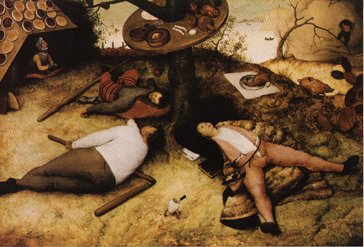
In 1567, Pieter Brueghel the Elder painted The Land of Cockaigne. It shows the renaissance notion of utopia, fat people lying around eating chicken legs. Modern day America has already reached this particular heaven thanks to the efforts of Colonel Saunders. The world is aiming for shopping as ultimate bliss. If we don’t change direction, that’s where we will go.
As I see it, this crisis [the great depression] differs in character from past crises in that it is based on an entirely new set of conditions, due to the rapid progress in the method of production. Only a fraction of the available human labor in the world is needed for the production of the total amount of consumption-goods necessary to life.Our money systems are just away of automating the allocation of scarce resources and demand for maximal labour, much the way we did things in cave society. They are flummoxed when confronted with an oversupply of either labour or resources.
~ Albert Einstein (1879-03-14 1955-04-18 age:76)
When a corporation introduces technology, this creates pain and gain. The corporation fires workers, thus handing them 100% of the pain and keep 100% of the gain in reduced costs for themselves. This creates increased unemployment. The extra pool of workers reduces their value, depressing wages. To make ends meet these people must work longer hours, perhaps at two jobs. This creates even more unemployment by soaking up two jobs per person.
The middle class is thus increasingly unemployed and decreasingly paid. This means they can no longer afford to buy as much as they used to. This means the elite, who own the means of production, start to lose money because they have been systematically eliminating each other’s customers.
One way out of this spiral, favoured by 80% of Canada’s economists, is a guaranteed annual income, (sometimes called negative income tax). The elites are panicked by the notion of transfer of their funds to others, but it is really just to correct an instability that is creating an exploding wealth gap and collapsing middle class. It just restores the same sort of wealth distribution that was so pleasant for all in the 1950s.
 |
recommend book⇒The Parachute | |||
| by | Sinclair Dumontais and Patricia Claxton | 978-1-55263-734-0 | paperback | |
|---|---|---|---|---|
| publisher | Key Porter | |||
| published | 2007-06-15 | |||
| A satirical novel about how capitalism destroys the middle class on which it feeds. | ||||
| Greyed out stores probably do not have the item in stock. Try looking for it with a bookfinder. | ||||
The most likely way our work ethic will crack is that employees will come to realise they are modern serfs, exploited by corporations. There is no honour in slavery. They will gradually demand more and more say in how they perform their work. Work will gradually transform into play.
Man has had to work hard just to survive ever since the invention of agriculture. No work, no food. But now we have to rethink that ancient wisdom and find a new paradigm to share the pie, now that work is losing its value. To everyone’s horror, it will sound a bit like Communism — everyone gets a slice just for being alive, a guaranteed annual minimum income.
 |
This page is posted |
http://mindprod.com/money/work.html |
Optional Replicator mirror
|
J:\mindprod\money\work.html | |
 |
Please read the feedback from other visitors,
or send your own feedback about the site. Contact Roedy. Please feel free to link to this page without explicit permission. | |
| Canadian
Mind
Products
IP:[65.110.21.43] Your face IP:[216.73.217.43] |
| |
| Feedback |
You are visitor number | |


