A Decent Kettle
©1996-2017 Roedy Green of Canadian Mind Products
Disclaimer
This essay does not describe an existing computer program, just one that should exist. This essay is about a suggested student project in
Java programming. This essay gives a rough overview of how it might work. I have no source, object, specifications, file layouts or anything
else useful to implementing this project. Everything I have prepared to help you is right here.
This project outline is not like the artificial, tidy little problems you are spoon-fed in school, when all the facts you need are included, nothing extraneous is mentioned, the answer is
fully specified, along with hints to nudge you toward a single expected canonical solution. This project is much more like the real world of messy problems where it is up to you to fully the
define the end point, or a series of ever more difficult versions of this project and research the information yourself to solve them.
Everything I have to say to help you with this project is written below. I am not prepared to help you implement it; or give you any additional materials. I have too many
other projects of my own.
Though I am a programmer by profession, I don’t do people’s homework for them. That just robs them of an education.
You have my full permission to implement this project in any way you please and to keep all the profits from your endeavour.
Please do not email me about this project without reading the disclaimer above.
Introduction
My parents used the same dome-shaped GE electric
kettle all their adult lives. A friend showed me a Sunbeam electric frying pan I gave her
for her wedding back in the 1960s still working daily. Yet the
kettles I buy today are utterly hopeless. They are designed to self destruct within
12 months or less. They scald the user with steam, hot water or
hot metal. They are difficult to use. Making a something as simple as a kettle difficult
to use takes talent. I have nothing but angry things to say about most kettle designs.
Your job is twofold, to come up with a decent mechanical design and to write the
programming to simulate the control system for the sensors. You might look at high end
kettles such as the Braun, Cuisinart, Oster and Toastess for ideas. Assume money is no
object.
Attributes of a Good Kettle
Here are the attributes of a good kettle:
- Durable. It a crime against nature to create non-recyclable, disposable
objects.
- The kettle should not scald or burn the user. This means it must be difficult for
the user to get her hand in the flow of any steam or water. It should not burn you if
you touch it in the wrong place. It should not spit if you pour while the water is
still boiling. Perhaps the kettle could be designed like a steel Thermos bottle so that
the outside surface stays cool, both to save energy and to avoid burning the user.
- It should be easy to tell from a distance the three states of the kettle: off
(dark), coming to a boil (red) and ready (green). All of today’s kettles have at
most a two-state indicator.
- When the water is ready, it should make a cheerful noise to tell you, not just in
inaudible click. The sound can be made electronically. It does not have to be a steam
whistle.
- People often set water on to boil during a TV commercial then forget and come back
later and the water is cold again. Deal with this in three ways:
- a whistle when the water is ready (not necessarily a steam whistle). It can be
a cellphone-style ringtone.
- Insulate the kettle so the water stays hot after the delay.
- Use an indicator to let the user know the water is still hot after the
delay.
- The control to turn the kettle on and off should be large, prominent and obvious.
You want guests to be able to use the kettle without training.
- The kettle should be easy to clean inside and out. You need to be able to scour out
mineral deposits. This means the inside of the kettle should be cavernous without
various pipes and protuberances that are difficult to clean.
- It should be easy to tell just how much water is in the kettle. Looking at water is
a glass window is not good enough. You need an easy-to-read indicator. Perhaps you
could use a LED (Light-Emitting Diode)
strip that uses weight to calibrate the degree of fullness.
- If you turn the kettle on without water, it should immediately turn off, not fry
the element.
- The kettle should encourage you, but not demand, that you empty boiled water from a
previous boiling and refill with fresh cold water.
- The kettle should turn off before it boils completely dry to avoid baking on
minerals and frying the element.
- Energy efficiency. Don’t needlessly radiate energy. See what you can with the
kettle’s microprocessor to train the user to boil just the amount needed, no
more.
- Consider warning the user about poor water quality, too warm, too
cloudy…
- Design the base so that if the counter that the kettle rests on floods, it does no
damage.
Implementation
Your sensors might measure conductivity, weight, temperature, contacts with the
base…
Consider using an induction rechargeable battery in the kettle so that the
microprocessor can continue to function even when the kettle is removed from the base or
is not firmly settled on the base.
The Plumbed Kettle
Consider a second design that uses a built-in unit with water supply plumbing. You
would put your cup or pot underneath and push a button to select the amount of water you
want boiled and poured. You put your cup on tray under the unit and it warms just that
amount of water and trickles it into the cup. It does not maintain a hot
water tank, unless you can figure out how to superinsulate it. It might keep a
small supply, say a cupful ready to go immediately.
Toastess KJK-55
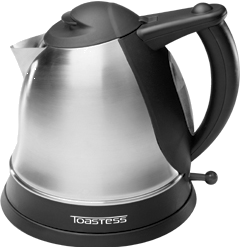
This was my immediately previous kettle that died a premature death.
- The Toastess has a big red (shown grey in the illustration) lever on-off with a
knob on the end. It is obvious and easy to use.
- It is easy to fill.
- It turns off reliably when the water boils
- It does not whistle.
- The on-light is placed on the kettle so that it is hard to see.
- After a few months of use it stopped heating water, though the red light worked
perfectly.
- It scalds you.
Oster 5966-33
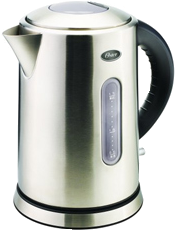
This is the kettle I have now. It is a reasonably good kettle:
- It is sturdy.
- It is easy to clean inside and out.
- It does not usually scald you when you pour water out.
- It has a hypnotic sexy blue flickering light to let you know it is on.
- It is tall and skinny. This lets you boil a small amount of water at a time.
- The various logos and decorative trim are wearing off.
- It makes no noise when the water is ready.
- It burns you if you touch the metal body.
- It is hard to tell how much water is in it. It has a water-lever viewing window but
it is small and the water line is indistinct, so it is easy to start the kettle up
empty. You mainly have to tell how much water is in it by weight. The problem is
one cupful feels very much the same as empty.
- It is not very clever about quickly turning off if there is no water and quickly
recovering once you refill it. It goes into a sulk for 15 minutes or so.
- It stopped working, but this was because the contacts on the base and the bottom of the kettle were corroded.
I cleaned them and treated them with DeoxIT Red and I have had no trouble since.
Books
Book referral for The Design of Everyday Things
 |
recommend book⇒The Design of Everyday Things |
| by |
Donald A. Norman |
978-0-385-26774-8 |
paperback |
|---|
| birth |
1935-12-25 age:82 |
978-0-465-06709-1 |
hardcover |
|---|
| publisher |
Currency |
978-0-465-00394-5 |
eBook |
|---|
| published |
1990-02-01 |
978-1-4526-0412-1 |
audio |
|---|
| |
B003KVKYAM |
kindle |
|---|
| Though this is not particularly about designing GUIs, I love this book. It was like meeting somebody else who understood my frustration with the ineptness in the design of user interfaces for computer programs, household appliances and just about anything mechanical. He grabbed ill-formed ideas out of my mind and laid them clearly on paper. A classic. The principles behind creating simple, useful, easy to understand appliances. Much of this thinking also applies to computer programs. This is a great read, highly entertaining. This book is sold under three alternate ISBNS: paperback:978-0-465-06710-7, 978-0-465-05065-9, 978-0-385-26774-8. |
|
| Greyed out stores probably do not have the item in stock. Try looking for it with a bookfinder. |