


Here is a rule of thumb. If your application is so complicated that it will have to be distributed over several servers, have a look at EJB. If not, use a simpler technology.
Enterprise beans don’t have a GUI (Graphic User Interface) interface. Enterprise Java Beans speak CORBA (Common Object Request Broker Architecture) IIOP (Invocation over Internet Inter-Orb Protocol) for their RMI (Remote Method Invocation). Session Beans maintain conversational context for one client. Entity beans cache data for one row of a database. Entity beans also provide a simple persistent object database, indexed by a primary key. The Entity bean learns its primary key at create time and may persist indefinitely. Beans make it easier to implement transaction logic with commit/rollback. The transaction processing logic helps keeps beans from interfering with each other. EJBs use JNDI to find objects. They use RMI (regular or IIOP Corba) to communicate between servers. They use JTA (Java Transaction Application programming interface) for transaction management.
The point of EJB is to fob much of the work of concurrency, transaction handling and persistence off on the container so the beans can concentrate on business logic.
There are several types of beans. This diagram outlines them:
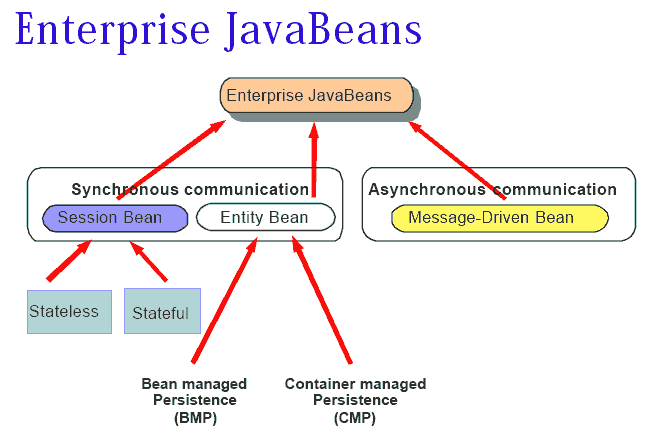
Beans communicate via two proxy objects, one that implements the bean’s home (bean-finding) interface and one that implements its remote (business-logic) interface. The indirection allows the EJB container to intercept the calls and add functionality such as persistence.
Using EJBs also takes away a number of things. You are not allowed to do certain things within the EJB container, e. g., you should not create threads, do file IO, listen on a socket, etc.
 |
recommend book⇒Enterprise JavaBeans 3.1, sixth edition | |||||||||||||||||||||||||||||||||||||||||||||||||||||||
| by | Bill Burke, Richard Monson-Haefel | 978-0-596-15802-6 | paperback | |||||||||||||||||||||||||||||||||||||||||||||||||||||
|---|---|---|---|---|---|---|---|---|---|---|---|---|---|---|---|---|---|---|---|---|---|---|---|---|---|---|---|---|---|---|---|---|---|---|---|---|---|---|---|---|---|---|---|---|---|---|---|---|---|---|---|---|---|---|---|---|
| birth | 1971 age:46 | 978-1-4493-9696-1 | eBook | |||||||||||||||||||||||||||||||||||||||||||||||||||||
| publisher | O’Reilly  |
B0046RERXO | kindle | |||||||||||||||||||||||||||||||||||||||||||||||||||||
| published | 2010-09-17 | |||||||||||||||||||||||||||||||||||||||||||||||||||||||
| covers JBOSS. Also high level information for managers and tips on design. | ||||||||||||||||||||||||||||||||||||||||||||||||||||||||
| ||||||||||||||||||||||||||||||||||||||||||||||||||||||||
| Greyed out stores probably do not have the item in stock. Try looking for it with a bookfinder. | ||||||||||||||||||||||||||||||||||||||||||||||||||||||||
 |
recommend book⇒Building Java Enterprise Applications Volume I: Architecture | |||||||||||||||||||||||||||||||||||||||||||||||||||||||
| by | Brett McLaughlin | 978-0-596-00123-0 | paperback | |||||||||||||||||||||||||||||||||||||||||||||||||||||
|---|---|---|---|---|---|---|---|---|---|---|---|---|---|---|---|---|---|---|---|---|---|---|---|---|---|---|---|---|---|---|---|---|---|---|---|---|---|---|---|---|---|---|---|---|---|---|---|---|---|---|---|---|---|---|---|---|
| publisher | O’Reilly | |||||||||||||||||||||||||||||||||||||||||||||||||||||||
| published | 2002-03 | |||||||||||||||||||||||||||||||||||||||||||||||||||||||
| Aimed at experienced developers. Filled with particularly good advice on using EJBs and LDAP directory services Highly recommended. First volume of a three volume set on EE. | ||||||||||||||||||||||||||||||||||||||||||||||||||||||||
| ||||||||||||||||||||||||||||||||||||||||||||||||||||||||
| Greyed out stores probably do not have the item in stock. Try looking for it with a bookfinder. | ||||||||||||||||||||||||||||||||||||||||||||||||||||||||
 |
This page is posted |
http://mindprod.com/jgloss/ejb.html |
Optional Replicator mirror
|
J:\mindprod\jgloss\ejb.html | |
 |
Please read the feedback from other visitors,
or send your own feedback about the site. Contact Roedy. Please feel free to link to this page without explicit permission. | |
| Canadian
Mind
Products
IP:[65.110.21.43] Your face IP:[18.118.226.105] |
| |
| Feedback |
You are visitor number | |


